
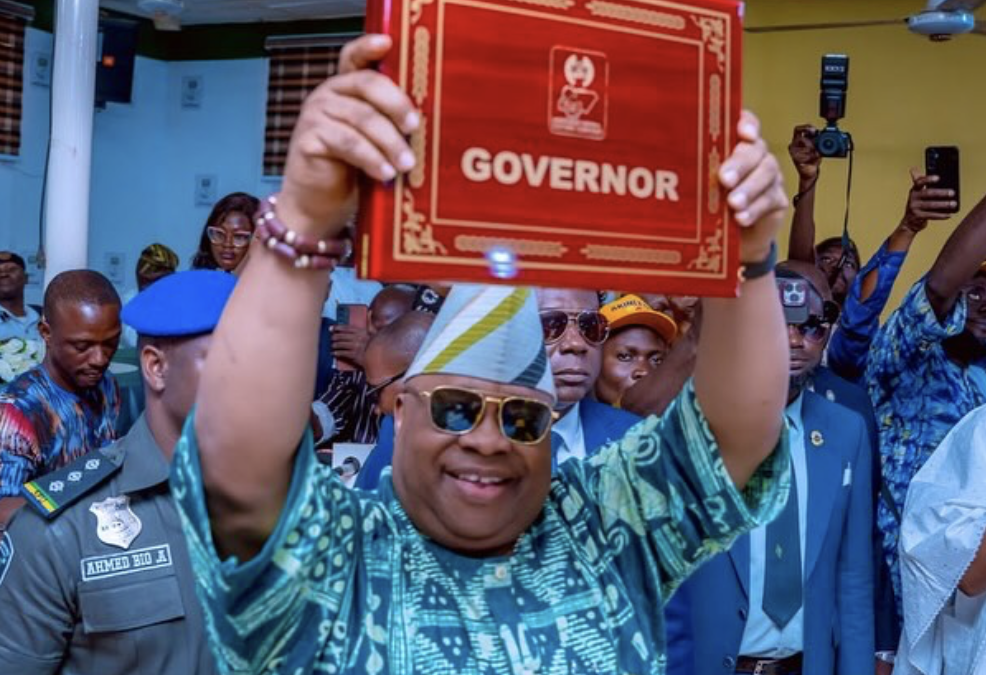
On 15 August 2026, the people of Osun State returned to the polls and elected Governor Ademola Adeleke for another four years in office. Adeleke, who contested on the platform of the Accord Party, polled 511,067 votes to defeat the All Progressives Congress candidate, Bola Oyebamiji, who received 444,815 votes. He won by a margin of 66,252 votes and secured 19 of the state’s 30 local government areas.
At the election, 43% of the state’s 2.34 million registered voters showed up to vote. This is not a majority of the electorate, but it is a meaningful level of participation for a state governorship election in Nigeria. The re-election of Gov. Adeleke extends his administration that began in November 2022.
This is not an article about Gov. Adeleke’s political history or the intricacies behind the election. It is a spotlight on the promises of his administration, what was delivered in the first term, where the record falls short, and what the governor is now promising to do with another four years.
Infrastructure is arguably one of the most visible achievements of Gov. Adeleke’s first term. It is also closely connected to the larger economic question facing Osun: whether the state can use public infrastructure to move beyond its reputation as a civil service state and build a more productive, investment driven economy.
The 2022 Agenda and the Infrastructure Promise
Gov. Adeleke’s campaign for office in 2022 was focused on five broad manifesto:
- workers’ welfare
- economic development
- infrastructure renewal
- people-focused social services, and
- agro industrialisation.
Infrastructure renewal was tied to the broader ambition of improving economic activity across the state. The thinking was around better roads, bridges, water systems, healthcare facilities and schools would improve living conditions while also making it easier for businesses, farmers and communities to participate in the economy.
Almost a year into the administration in October 2023, the Governor unveiled a N100 billion infrastructure development plan. The plan covered 45 roads across the state’s 30 local government areas, five flyovers, the rehabilitation of 345 healthcare facilities, potable water projects and the reconstruction of 31 schools.
The administration said the projects would be funded without borrowing from financial institutions and would prioritise local contractors and suppliers. The scale of the plan was significant for a state with substantial infrastructure deficits. More importantly, it established the direction of the administration’s first term: visible capital projects that could be seen and experienced by residents across the state.
By March 2025, when the government unveiled a second infrastructure plan worth approximately N159 billion, Adeleke said the first phase had produced more than 150 kilometres of reconstructed, rehabilitated or renovated roads, 200 primary healthcare centres and 99 schools, with several major road dualisation and flyover projects at different stages of completion. By July 2026, the administration was putting the number of roads executed across the state at more than 300 kilometres, while describing more than 27 kilometres of intra city roads in Osogbo as completed.
The numbers have grown considerably over the course of the administration. The question is what was indeed delivered?
What was Delivered?
Across the state, roads that had become difficult to use were rehabilitated, while new roads were constructed to improve connections between communities. In Ife North, for example, the administration completed the 10.4 kilometre Edunabon to Tonkere Road shortly before the election. The project had reportedly been abandoned for almost four decades. The government also completed the 3.3 kilometre Akinlalu Junction to Akinlalu Town Road and the 1.5 kilometre Yakooyo to Magistrate Court Road, including the spur to Itamerin. Work is still ongoing on the 3.3 kilometre Market Square to Tollgate Road in Ipetumodu.
These may not be the projects that attract national attention, but they illustrate one of the more important elements of the administration’s infrastructure strategy: reconnecting communities and restoring road networks that support everyday economic activity.
The administration also pursued the dualisation of several major roads and constructed flyovers in Osogbo and Ile Ife. The 672 metre LAMECO flyover in Osogbo was commissioned on 1July 2026, while the Oke Fia flyover was commissioned in August, shortly before the election.
There is also a broader infrastructure programme covering roads in Iwo, Ila Orangun, Obokun, Oriade, Ile Ife, Ifetedo, Ikirun and Osogbo, among others. The administration has described this as an attempt to spread infrastructure development across major towns rather than concentrate it in the state capital.
The significance of these projects goes beyond appearance. Osun is a geographically connected state with agricultural communities, commercial centres and educational institutions spread across its local governments. As such, roads are essential economic infrastructure for Osun state. They determine how easily people move, how quickly agricultural products reach markets and how accessible public services are.
Adeleke’s first term made progress on basic connectivity
The administration also made progress on the fiscal side of infrastructure delivery. Domestic debt reportedly fell from N148.37 billion in December 2022 to N83.32 billion by March 2025, while internally generated revenue increased from N27.72 billion in 2023 to N54.7 billion in 2024. A stronger revenue position and lower domestic debt provide more room for a state government to finance capital expenditure without relying excessively on new borrowing.
This is important because infrastructure delivery is ultimately a financing question. Roads and flyovers require money not only to construct but also to maintain.
First term was not without infrastructure gap
For all the construction, Adeleke’s infrastructure record also raises questions about quality, completion and the economic returns from the projects.
The most immediate example came in July, when the newly commissioned LAMECO flyover developed visible defects less than a month after it was opened. The state government temporarily closed the affected section and ordered repairs, while blaming the damage on sabotage and vandalism.
The cost of infrastructure should not be measured only by the cost of construction. The real cost includes maintenance, repairs and the economic losses that arise when public assets fail prematurely.
There is also the issue of unfinished projects. Adeleke’s administration made completion of inherited projects a recurring theme of its infrastructure policy. Some have been completed, while others remain ongoing. The second phase of the infrastructure plan unveiled in 2025, for example, included inherited roads such as the Osogbo to Iwo to Oyo State boundary road and the Osogbo to Ikirun to Insha to Kwara State boundary road.
This is not necessarily a failure. Large infrastructure projects often span multiple budget cycles and administrations. But it does mean that the second term will have to deal with a sizeable pipeline of projects already in progress while also pursuing a new development agenda.
The Second Term is About More Than Roads
During campaigns for second term, the governor introduced what he called an upgraded five point agenda. The priorities are:
- youth, women and workers’ welfare and empowerment;
- infrastructure consolidation for citizens’ social and economic wellbeing;
- agro-industrial expansion; affordable and qualitative access to health and education; and
- an improved and secure business environment for job creation.
The first term was largely about addressing infrastructure deficits. The second term is being presented as an opportunity to use that foundation to drive economic transformation. That ambition is perhaps best captured by Adeleke’s stated desire to move Osun away from its traditional identity as a civil service state.
Following his re-election, the governor said he wanted to transform Osun into an industrial state capable of attracting investors. His administration has previously identified the revival of the state’s free trade zone and agricultural processing zones as part of this broader objective.
The idea is not entirely new. The administration began discussing the free trade zone and business growth initiative as early as 2023. What is different now is that industrialisation has become a central feature of the second term narrative.
From Civil Service State to Industrial State
Building an industrial economy requires a different kind of infrastructure from simply constructing roads. A manufacturer needs reliable electricity, water, transport links, industrial land, security, telecommunications and efficient government processes. An investor also needs confidence that the regulations will remain relatively stable and that the business environment will not become unpredictable.
A free trade zone can provide a location for investment, but the zone itself does not create investment. An airport can improve connectivity, but an airport does not automatically create an aviation economy. A road can reduce travel time, but it does not by itself create jobs.
The real test of Adeleke’s second term will therefore be whether the physical infrastructure developed during his first term can be connected to a broader economic strategy. The state’s agricultural base provides one obvious opportunity.
Institutional Conflicts
There is another lesson from Adeleke’s first term that cannot be ignored. Infrastructure is ultimately delivered to people through institutions. When those institutions are weak or caught in prolonged political disputes, even well funded projects can struggle to achieve their intended impact.
The dispute over Osun’s 30 local governments was one of the most consequential political conflicts of the first term. The federal government withheld local government allocations from March 2025, while the state government challenged the decision in court. In December 2025, the Supreme Court struck out the state’s suit on the ground that the state Attorney General lacked the legal standing to institute the case on behalf of the local governments, although the court also held that the federal government was wrong to seize the funds belonging to the local governments.
Roads, schools, healthcare centres, markets, water projects and other forms of public infrastructure ultimately serve communities. A state government’s ability to deliver development therefore depends not only on how much it spends but also on how effectively the different levels of government function together. For the second term, institutional stability will be just as important as capital spending.
What Should we be Watching?
Adeleke’s re-election gives him four more years to complete the work he started and test the more ambitious promises of his second term. His first term established infrastructure as the most visible part of his administration’s record. The second term will determine whether that infrastructure becomes the foundation for something bigger. The challenge is no longer simply to build more roads or commission more flyovers. It is to make the roads, bridges, schools, healthcare facilities, water projects and other infrastructure work together as part of a coherent economic strategy.